 |
| Edge of the Empire Beginner Box Contents |
ABOUT THE SYSTEM
Fantasy Flight's RPG isn't based on the 20-sided die mechanic that many roleplayers might be familiar with, such as from Dungeons and Dragons. Instead, their system uses a set of custom dice, which many found to be a controversial choice.
I admit, I initially felt like this was a money grab, but I have seen been won over. Their dice combines with some other unique mechanics and results in a highly narrative system that feels like a combination of 5th edition D&D and the so-called "play by the apocalypse" style roleplaying games.
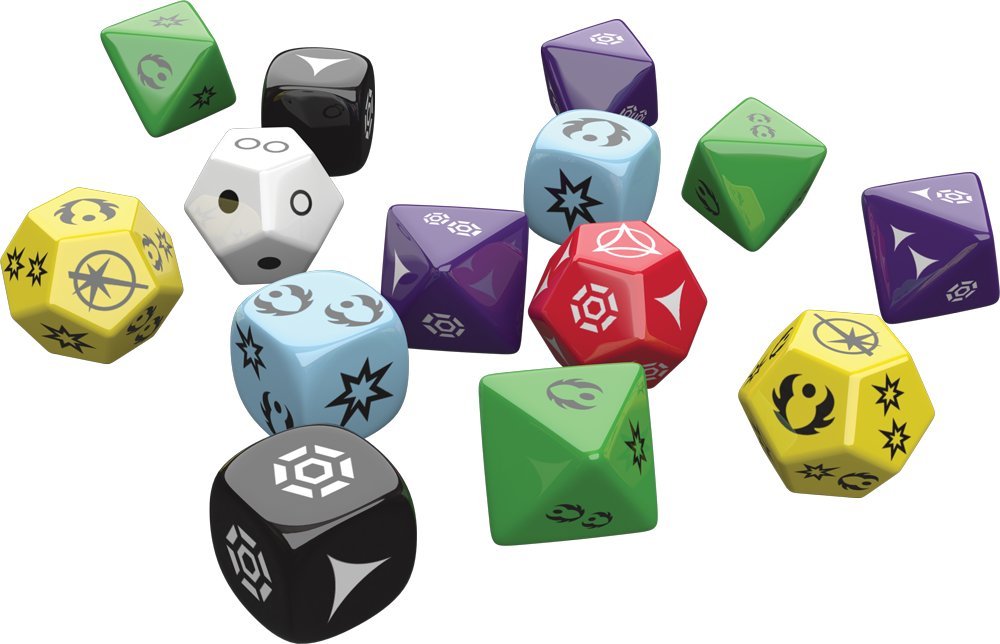 |
| Fantasy Flight's Star Wars RPG Dice |
In Dungeons and Dragons, narrative control is entirely in the hands of the dungeon master. While there is meant to be some push and pull between the game master and the players, in the end all decisions come down to the GM, and the GM has the final say in how much creative influence the players have on the world and the narrative as a whole.
In games such as City of Mist, FATE, and other "play by the apocalypse" (or PBTA) rpg systems, the players have a very large level of influence over the narration and the world as a whole. Depending on how those games are run, players might have more influence over the world, how non-player characters react to them, and the overall story line than even the GM does.
Fantasy Flight's Star Wars RPG strikes what I consider to be a happy medium between the two. The game master in Fantasy Flight's system still has most of the control over the world, characters, and events unfolding. However, through interpreting mixed successes and the use of "destiny points", which represents the "the force", the players still do have influence over the world.
For example, let's say the party gets stranded on a planet with an unbreathable atmosphere. They check their inventories and, oops, none of them have breath masks. They flip one of their shared destiny points and say "Thankfully we rememebered to buy breath masks as the last port, just in case!". Or let's say the party is running away from a squad of stormtroopers, and looking for a place to hide. They can flip a destiny point and say "Since my character is from here, he knows of a local tavern that is just around the corner which is usually very busy at this time of day. We round the corner and duck inside and try to blend in with the crowd".
ABOUT THE DICE
The dice itself leads to situations where the players can influence the world. This comes in the form of "success vs failure" and "threat vs advantage". When rolling dice, success symbols cancel out failure symbols, while advantage symbols cancel out threat symbols. You can, for example, succeed with threat or fail with advantage.
 |
| Dice Categories |
Let's say you're trying to hack into a console. You roll and have 2 net success and 1 net threat. You succeeded, which means you successfully hack into the console. For the threat, maybe you trip an alarm in the system, so now the empire knows you're inside their base.
But what if you rolled 2 net failure and 1 net advantage instead? You fail, which means you don't successfully hack into the console, but your advantage could be that you don't set any of the alarms off, or you accidentally unlock all of the doors on your level somehow.
This interplay of success/failure and advantage/threat is highly narrative. It's a very neat system in which the imply what happens, and it's up to the GM and the players to interpret them. The players can recommend what the threat might be, and they're allowed to choose what they want their advantages to be. This gives them some extra influence over the world, though the last say always comes down to the GM.
This interplay of success/failure and advantage/threat is highly narrative. It's a very neat system in which the imply what happens, and it's up to the GM and the players to interpret them. The players can recommend what the threat might be, and they're allowed to choose what they want their advantages to be. This gives them some extra influence over the world, though the last say always comes down to the GM.
THE DIFFERENT CORE BOOKS
 |
| FFG's SW RPG Core Books |
One of the more confusing things about Fantasy Flight's Star Wars RPG is the different core books. There are there different core books, Edge of the Empire, Age of Rebellion, and Force and Destiny. Each of them are not different systems. In fact, about half of each book is exactly the same, since they are based on the same core rules.
Each source book is designed to cater to a different type of adventure. Edge of the Empire is about smugglers, living on the outer rim, flying by the seat of your pants. Think Han Solo, Greedo, and Jabba the Hutt. These characters can be about exploring the unknown, finding that big score, hunting down an enemy from their past, etc.
Age of Rebellion is about the rebellion. Think of the Luke/Leia and the struggle against the empire. Aiding the resistance, running missions for the rebels, and trying to take back the the galaxy from the evil empire.
Force and Destiny is the core book that is all about force users. Be a jedi in a world where jedi have been all but extinguished. Quest to build your own lightsaber, help those you can, and investigate disturbances in the force.
Now which module to choose? It depends on what type of adventure you want to run! If you don't really care, go with Edge of the Empire. It has been out the longest, and has the most material and published adventures. If your friends love the idea of being a force user, using a lightsaber, and living out their jedi fantasy, go with Force and Destiny. The other core books allow you to build force sensitive characters with some force abilities, but you really need Force and Destiny to build a full-on jedi.

Overall, the system is fantastic and I fully recommend it. Go grab whichever one of the beginner boxes interests you the most and give it a try. If you have no preference or can't decide, just go with the Edge of the Empire beginner box. There's a free follow-up adventure to the beginner box called "Long Arm of the Hutt" available on their website.
Once you finish the beginner box, if you're digging the system, buy the corresponding sourcebook and a few extra sets of dice. Alternatively you can download FFG's dice roller app for $5.
You don't need a battle mat or miniatures, since this system is very narrative and isn't grid-based. It is an option, however, if you want to roughly sketch out the terrain as a reference.
Each source book is designed to cater to a different type of adventure. Edge of the Empire is about smugglers, living on the outer rim, flying by the seat of your pants. Think Han Solo, Greedo, and Jabba the Hutt. These characters can be about exploring the unknown, finding that big score, hunting down an enemy from their past, etc.
Age of Rebellion is about the rebellion. Think of the Luke/Leia and the struggle against the empire. Aiding the resistance, running missions for the rebels, and trying to take back the the galaxy from the evil empire.
Force and Destiny is the core book that is all about force users. Be a jedi in a world where jedi have been all but extinguished. Quest to build your own lightsaber, help those you can, and investigate disturbances in the force.
Now which module to choose? It depends on what type of adventure you want to run! If you don't really care, go with Edge of the Empire. It has been out the longest, and has the most material and published adventures. If your friends love the idea of being a force user, using a lightsaber, and living out their jedi fantasy, go with Force and Destiny. The other core books allow you to build force sensitive characters with some force abilities, but you really need Force and Destiny to build a full-on jedi.
HOW TO START

Overall, the system is fantastic and I fully recommend it. Go grab whichever one of the beginner boxes interests you the most and give it a try. If you have no preference or can't decide, just go with the Edge of the Empire beginner box. There's a free follow-up adventure to the beginner box called "Long Arm of the Hutt" available on their website.
Once you finish the beginner box, if you're digging the system, buy the corresponding sourcebook and a few extra sets of dice. Alternatively you can download FFG's dice roller app for $5.
You don't need a battle mat or miniatures, since this system is very narrative and isn't grid-based. It is an option, however, if you want to roughly sketch out the terrain as a reference.

No comments:
Post a Comment